Case studyAMCA

A congress system that has grown with AMCA for more than 10 years
For AMCA – Academic and Medical Conference Agency – we develop and maintain the system participants use to register for scientific congresses, conferences and courses. It covers registrations, payments, tax documents, accommodation, and the submission and review of abstracts. In Czech and English.





- of work on one system
- 10+ years
- a bilingual system
- CZ · EN
- built on Ruby on Rails
- Rails
01In brief
What iQuest develops and maintains for AMCA
The key facts of the project in one place – who the client is, what the system does and what part iQuest plays in it.
About the client
AMCA was founded in 2005 and has since organised hundreds of national and international medical, mathematics and physics and other scientific conferences, corporate events and classical music concerts. Besides organising events, it also offers association management to professional societies.
- year the agency was founded
- 2005
- participants at its largest event so far – EuropaCat 2023
- 2,500
- events in the public archive for 2015–2026
- 323
Source: amca.cz and AMCA. EuropaCat 2023, the 15th European Congress on Catalysis, took place at the Prague Congress Centre.
The project in brief
- Client
- AMCA, spol. s r. o. – Academic and Medical Conference Agency, Prague
- Industry
- Organising scientific congresses, conferences, workshops and cultural events; association management
- System
- Custom web-based congress and registration system
- What it covers
- Participant registration, payments, tax documents, accommodation, extras, abstracts and their review, exports
- iQuest's role
- Rewrite of the original system in Ruby on Rails, further development, maintenance and support
- Technology
- Ruby on Rails, web application
- Languages
- Czech and English
- Collaboration
- More than 10 years and ongoing
02Starting point
A system of its own that needed a new foundation
AMCA already had a system of its own before we joined the project. But it was written in a different language on an old framework, and its registration form was hardcoded – the same for every event. Adapting it to a particular congress meant a programmer had to step in.
Originally
- An old programming language and framework
- Registration form hardcoded
- The same fields for every event
- A system for the agency's own events only
We rewrote the system in Ruby on Rails and have been extending it in small steps ever since – always based on what the next events need.
What the system does today
- A form for every eventThe agency sets the fields, participant categories and fees for each event itself.
- Payments through every channelCard online, bank transfer with statement import, and cash on site.
- Documents and vouchersTax documents and accommodation vouchers are created automatically.
- Abstracts and reviewSubmission of abstracts and full papers, and their review in several stages.
- ExportsComprehensive data exports for the organising and programme committees.
- Access for the agency's clientsThe agency can open part of the administration to its own clients.
03The whole event
One congress, one system
Walk through a congress as a participant and as an organiser. Every place in the building has its counterpart in the system – pick a number on the model.
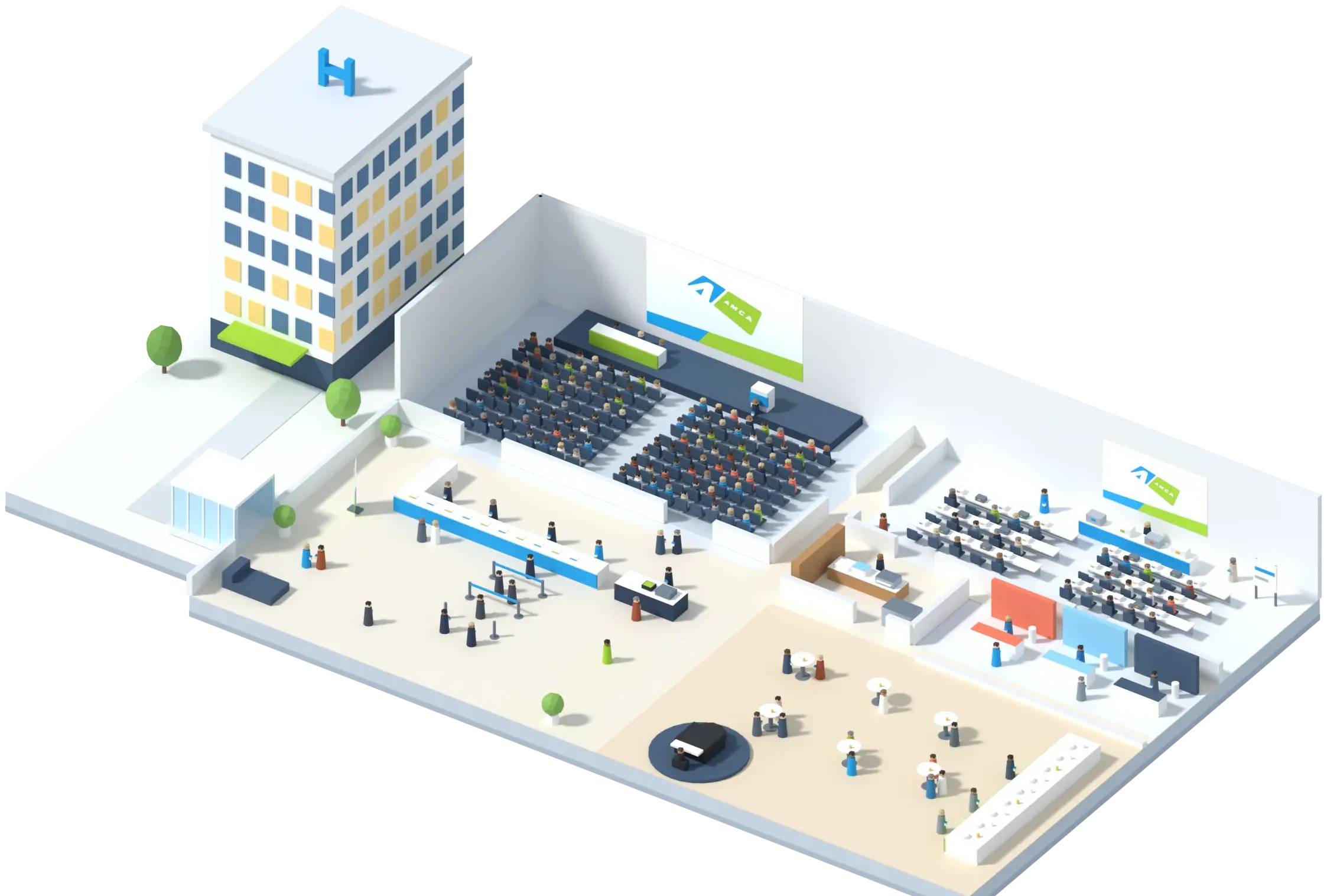
Registration desk
Registration
Participants arrive already registered. Their form was set up exactly for this event – participant categories, membership of the professional society, deadlines and fees.
- A separate form for every event
- Group registration from one account
- Registration changes until the deadline
What the system handles at each place of the congress
- Registration desk: Registration
- Participants arrive already registered. Their form was set up exactly for this event – participant categories, membership of the professional society, deadlines and fees. A separate form for every event, Group registration from one account, Registration changes until the deadline.
- Cash desk: Payments
- Whoever hasn't paid in advance pays on site. Cash is paired with the registration in the system too – just like a card payment or a bank transfer. Card online, Bank transfer with statement import, Cash on site.
- Plenary hall: Programme
- The reviewers decide the final programme. They assess contributions right in the system, over several review stages if needed, and decide what to accept, what to accept with comments and what to reject. Submission of abstracts and full papers, Several review stages, Accept, comment or reject.
- Catering and social evening: Extras
- Lunches and a ticket for the social evening, even for an accompanying person, are ordered right in the registration form. Lunches, Social evening, Accompanying persons.
- Secretariat: Documents and exports
- The secretariat doesn't write documents by hand. The system issues tax documents and accommodation vouchers itself, and the data of the whole event can be exported. Automatic tax documents, Accommodation vouchers, Comprehensive exports.
- Congress hotel: Accommodation
- Participants book a room in the hotel at the venue right in their registration. The system then issues the accommodation voucher. Booking in the registration form, Accommodation voucher, Hotel at the venue.
04Participant journey
From the first sign-in to the tax document
This is how the websites of congresses organised by AMCA describe registration. With every step the badge gets another ribbon.

Account
One account for every event
Participants create an account in AMCA's registration system once. They then use the same e-mail and password to change their registration, submit an abstract and register for future events.
Registered
The event's own form
After signing in they fill in a new registration. The category and the fee follow what the organiser set for the event – membership of the professional society or the payment date, for example.
Extras
Lunch, evening, hotel
In the same form they order lunch, a ticket for the social evening, for an accompanying person too, and accommodation in the congress hotel.
Group
Registering a whole group
Registering colleagues doesn't take more accounts – several people can be registered from one. The confirmation goes both to the registered person and to whoever registered them.
Paid
Pay by card or bank transfer
Once the form is sent, a card payment link and a pro forma invoice for a transfer appear. Both also come in the confirmation e-mail.
Receipt
The tax document, all by itself
As soon as the payment reaches the event's account, the participant receives the tax document by e-mail. After signing in they can download it any time.
Each event sets its own deadlines, fees and cancellation terms.
05Payments and documents
Three ways money arrives, one registration
Every payment is paired with a specific registration in the system – whether it comes by card, by bank transfer or in cash on site. The registration then produces the documents and the organisers' reports.
Pick a payment method and follow where it goes.
- Tax documentBy e-mail and to download after signing in
- Accommodation voucherIssued automatically
- ExportsFor the secretariat and the event's committees
Card online: Participants get the payment link right after sending the form, and again in the confirmation e-mail.
Every event with its own fees
Every event has its own fees, categories and deadlines in the system. So the organiser can make the fee rise as the event gets closer.
- Early payment
- Later payment
- On site
06Abstracts
From a submitted abstract to the congress programme
A scientific event stands on its contributions. The system accepts abstracts and full papers, and reviewers decide on them right inside it – which in effect sets the event's final programme.
Submission
Authors send their abstract from their own account – the same one they use to register for the event.
Review
Reviewers assess the contributions right inside the system, over several review stages if needed.
Decision
They accept a contribution, accept it with comments, or reject it.
Programme
The accepted contributions make up the final programme. The organiser sets up the sections and forms of participation to suit the event.
The system is bilingual, Czech and English, so an international congress runs in it just as well as a national symposium.
07Rhythm of events
Dozens of events a year, year after year
The system has to carry the operations of an agency that runs dozens of events a year. This is AMCA's public archive of events for 2015–2026 – including what the pandemic did to them.
AMCA's events by year
323 events in the archive in total
| Year | Held | Online | Postponed | Cancelled |
|---|---|---|---|---|
| 2015 | 16 | 0 | 0 | 0 |
| 2016 | 19 | 0 | 0 | 0 |
| 2017 | 32 | 0 | 0 | 0 |
| 2018 | 23 | 0 | 0 | 0 |
| 2019 | 35 | 0 | 0 | 0 |
| 2020 | 12 | 3 | 7 | 11 |
| 2021 | 7 | 6 | 2 | 0 |
| 2022 | 34 | 2 | 0 | 0 |
| 2023 | 29 | 0 | 0 | 0 |
| 2024 | 30 | 0 | 0 | 0 |
| 2025 | 27 | 0 | 0 | 0 |
| 2026 | 28 | 0 | 0 | 0 |
* 2026 includes events that are still to take place.
Source: the public archive of events on amca.cz, as of September 2026. The chart shows the agency's events, not data from the system.
08Collaboration
More than ten years on one system
We didn't deliver a project and walk away. We keep developing the system as the next events require and take care of running it.
The start
Rewrite in Ruby on Rails
We rewrote the original system, built in a different language on an old framework, in Ruby on Rails. That opened the way to adding features faster.
Years of development
Features as events need them
Forms configurable for every event arrived, then bank transfers with statement import and cash payments, the review of contributions and access for the agency's clients.
Today
Maintenance and further development
We maintain, support and keep extending the system. In the client's words, it has "grown to truly enormous proportions and keeps growing".
Technology
- Ruby on Rails
- Web application
- CZ · EN
How we work together
- Development in small stepsWe add new features continuously. When the next event needs something extra, nobody waits for a big release.
- Maintenance and supportBesides development we make sure the system runs reliably – it holds deadlines, money and participants' personal data. More about our software support and maintenance.
What the client says about working with us
We have been working with iQuest for more than 10 years and I am glad that we chose this company back then. They build and maintain a comprehensive conference system for us, which has grown to truly enormous proportions over those years and keeps growing. The quality of their services is excellent and the way they think features through is absolutely perfect. I can only recommend iQuest's services to everyone and I am glad our long-term cooperation still continues! Always thoroughly professional conduct, quality of service and a great proactive approach.Frequently asked questions
Looking for a long-term development partner?
Tell us what's holding your current system back, or what you need help with. Together we'll work out what makes sense to extend, rewrite or build anew.
or just call or e-mail us